
Ultrasound Monitoring for Your IVF Cycle
LATEST FROM THE IVF EDUCATION BLOG
New IVF research and education explained in language you can understand.
"Expert IVF Ultrasound Monitoring in Las Vegas & Henderson"
⭐⭐ Schedule Your Appointment ⭐⭐
📅 How to Schedule Your IVF Monitoring Appointment
IVF Monitoring LV is conveniently located inside True Health Acupuncture.
When you call, you have reached the correct office.
📞 Call True Health Acupuncture (Home of IVF Monitoring LV)
702-475-0870
Simply tell our receptionist:
"I'm calling to schedule an appointment with IVF Monitoring LV for fertility ultrasound monitoring."
Our team schedules all IVF Monitoring LV appointments and will be happy to assist you.
Prefer to schedule online?
You can also book your appointment through the True Health Acupuncture online scheduling system.
Location
1535 W. Warm Springs Road, Suite 135
Henderson, NV 89014
IVF Ultrasound Monitoring
Follicle Monitoring
Early , 1st,2nd and3rd trimester ultrasounds
Meet Joyce Edwards, RDMS, L.Ac.
With over 45 years of experience in reproductive healthcare, Joyce specializes in fertility ultrasound monitoring and patient education.

Antibiotics and the Endometrial Microbiome
Antibiotics and the Endometrial Microbiome
If Bacteria Are Found, Do You Automatically Need Antibiotics?
As researchers learn more about the endometrial microbiome, fertility patients are hearing more about bacteria that may be present inside the uterus.
And that can lead to a very understandable question:
“If bacteria are found in my uterus, shouldn't I take antibiotics?”
Not necessarily.
Finding bacteria and diagnosing an infection are not the same thing.
The uterus may not be completely sterile
For many years, the uterus was generally considered a sterile environment. Newer molecular testing methods have challenged that idea by detecting bacterial DNA in samples taken from the endometrium.
Researchers are now studying whether certain patterns of bacteria are associated with implantation, pregnancy outcomes, and conditions such as chronic endometritis.
But there is an important distinction:
Detecting bacteria does not automatically mean those bacteria are causing disease.
That matters when deciding whether antibiotics are appropriate.
When might antibiotics be used?
Antibiotics may be recommended when there is a specific clinical reason to treat bacteria—for example, when a physician diagnoses or strongly suspects chronic endometritis, an inflammatory condition affecting the endometrial lining.
Chronic endometritis is different from simply having bacteria detected through microbiome testing.
A physician may consider the patient's history, symptoms, endometrial biopsy findings, laboratory testing, and other clinical information before deciding whether treatment is appropriate.
Why not simply treat every abnormal microbiome result?
It sounds logical:
Find unwanted bacteria → take antibiotics → improve the uterine environment.
Unfortunately, biology isn't always that simple.
The endometrial microbiome is still an evolving area of reproductive medicine. Researchers have not yet established one universally accepted definition of a “normal” or “ideal” endometrial microbiome for every IVF patient.
We also don't yet know whether changing a particular microbiome pattern will consistently improve implantation or, most importantly, live-birth rates.
Antibiotics can also affect bacterial communities beyond the organism being targeted. That is one reason antibiotics should have a clear clinical purpose rather than simply being used because bacteria were detected.
What about probiotics after antibiotics?
You may also hear recommendations for probiotics—particularly products containing Lactobacillus—after antibiotic treatment.
There is growing interest in whether probiotics can influence the reproductive tract microbiome, and some studies have reported encouraging results.
However, the evidence is not yet strong enough to say that every IVF patient should take probiotics or that probiotics will reliably improve IVF success.
The strain, dose, route of administration and duration of treatment may all matter.
This is another area where research is continuing to evolve.
The question I would ask
If your testing identifies bacteria and antibiotics are recommended, don't be afraid to ask your fertility specialist:
“What exactly are we treating?”
Then follow that with:
“What evidence suggests that treating this finding could improve my IVF outcome?”
Those two questions can help you understand whether your doctor is treating a diagnosed condition, such as chronic endometritis, or attempting to modify a microbiome finding whose clinical significance may be less certain.
The takeaway
The discovery of bacteria in the uterus has opened an exciting new area of fertility research.
But remember:
Bacteria do not automatically mean infection.
A microbiome result does not automatically mean antibiotics.
And changing the microbiome does not automatically mean improved IVF success.
Treatment decisions should be based on your individual history, clinical findings, and a thoughtful discussion with your fertility specialist.
As the science develops, we may learn much more about how—or whether—changing the endometrial microbiome can improve IVF outcomes.
For now, one of the most powerful things you can do is continue asking good questions.
Keep learning. Keep asking questions. And make decisions with your fertility team based on the best evidence available.
This information is for educational purposes and is not a substitute for individualized medical advice.
IVF Monitoring LV | Evidence-Based IVF Education

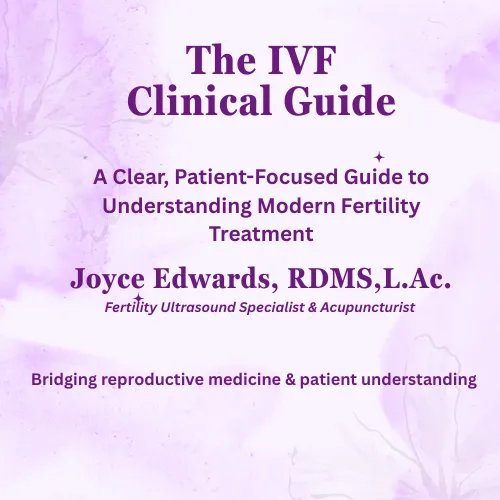
Understand IVF With Confidence
In vitro fertilization (IVF) involves a series of complex clinical steps that can be difficult for patients to fully understand while undergoing treatment. This guide provides a clear overview of the physiologic principles, treatment protocols, laboratory processes, and clinical decision points involved in modern IVF care. By translating reproductive endocrinology concepts into accessible language, the book helps patients better understand the procedures and discussions taking place throughout their treatment. It is designed to serve as an educational companion to the care provided by fertility specialists..
Intro Offer · $7
🌸 Join the IVF Monitoring Community
Receive new fertility articles, IVF research updates, and educational resources delivered directly to your inbox.
What patients are saying
Michelle A.
" Joyce at True Health Acupuncture is probably the best ultrasound technician I have ever had. She’s very personal and talks through everything… The comfort environment at True Health Acupuncture is unmatched. I highly, highly recommend her.”
— Michelle A.
IVF Monitoring Patient
Sara P.
“Joyce made my IVF monitoring experience so much easier. She explained what she was seeing during each ultrasound and always made me feel comfortable and informed. I highly recommend her to anyone going through IVF.”
-Sara P.
IVF Monitoring Patient

Nicole B.
“Joyce is an exceptional individual who made a significant impact during my IVF journey. Her ability to confirm our twin pregnancy was incredibly reassuring. Joyce took the time to explain everything she was observing, which not only made the experience more memorable but also helped alleviate my anxiety.”
— Nicole B.
IVF Monitoring Patient
Starting your cycle
Starting an IVF cycle is stressful enough, doing it with an out-of-state provider just increases that stress. That is why we have developed an out-of state monitoring program to help women that need ultrasound monitoring without having to travel to their provider. We follow your physicians instructions and with be able to accommodate your schedule. Most all cycles, whether retrievals or transfers, will need 2-3 ultrasounds during that cycle. All reports can be faxed or emailed to your physician within 2-3 hours after the exam is finished.
📩 Contact Joyce at IVF Monitoring LV
Have questions about fertility monitoring, IVF, or our educational resources? Choose the option that's most convenient for you.
💬 Quick question?
Text Joyce
📩 Need a detailed response?
Complete the contact form below.
📧 Want ongoing fertility education?
Join the IVF Monitoring Community.


